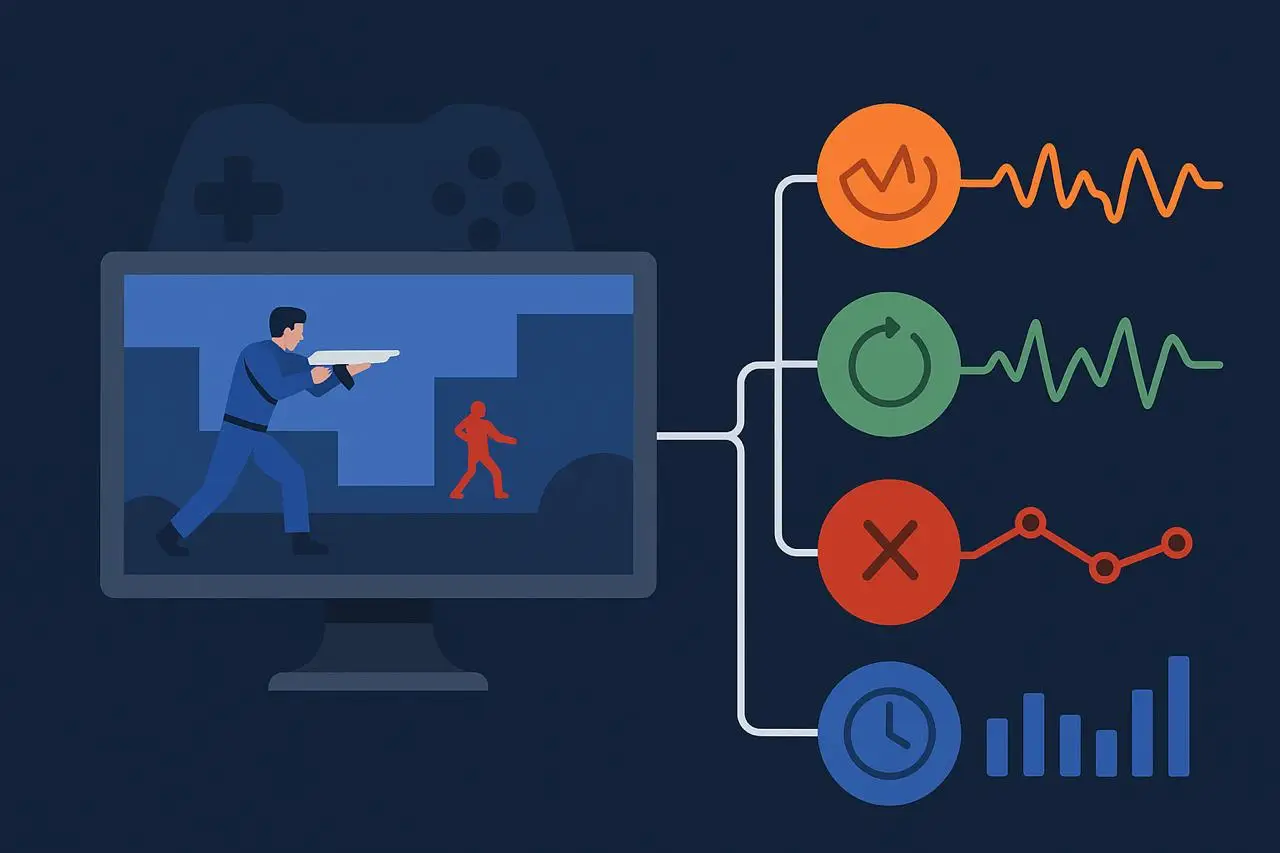
Each Kelvirox assessment is designed around a distinct, measurable dimension of gaming performance. No rankings. No progression pathways. Just structured data about how you perform.
The Individual Skill Assessment is Kelvirox's core product. It evaluates your performance across four distinct domains — reaction speed, strategic thinking, precision control, and team coordination tendencies — through a sequence of structured task modules.
Each domain is assessed separately before being compiled into an aggregate profile. Scores are not absolute — they are contextualised against anonymised platform data from users who completed the same assessment under comparable conditions.
Each domain uses a validated measurement approach drawn from cognitive and behavioural science literature. Where adaptations were made for the gaming context, these are documented in our methodology notes. The full assessment takes between 35 and 50 minutes.
Suitable for any player — casual or competitive — who wants a structured, neutral baseline of their current performance across multiple dimensions. No gaming history is required.
Results are informational only. No improvement guarantees.

This module is designed for users who want to examine reaction speed and targeting accuracy in isolation rather than as part of the broader Individual Assessment. It separates the two constructs deliberately, because conflating them is one of the most common errors in informal gaming performance discussions.
Reaction speed is measured through a series of timed stimulus-response tasks with varying complexity. Precision is measured through separate targeting tasks — static, dynamic, and predictive — that are timed independently to prevent reaction latency from influencing accuracy scores.
The session runs approximately 20–25 minutes. Results include a reaction speed distribution chart, a precision accuracy breakdown across task types, and a brief note on whether any meaningful relationship was observed between the two scores.
Particularly useful for players of action, shooter, and fighting game genres who want focused data on input performance, or anyone who has received conflicting information about their reaction abilities from informal tests.
Not a diagnostic tool. Results may vary across sessions.Strategic thinking in gaming is a multi-component construct. It involves anticipating opponent behaviour, managing multiple objectives simultaneously, allocating limited resources efficiently, and updating decisions when new information conflicts with earlier assumptions.
This module uses a sequence of structured problem scenarios to assess each component separately. Scenarios are presented in a game-agnostic format to reduce the advantage that players familiar with specific genres might otherwise have over those who aren't.
Results identify which components of strategic thinking appear strongest and which show lower scores — not to label these as weaknesses, but to give users a more precise picture of their decision-making tendencies. The report notes where individual component scores diverge significantly from the aggregate.
Suitable for players of strategy, MOBA, RTS, and team-based shooter genres, as well as any player curious about how they approach decision-making under time and information constraints.
Scenarios are illustrative, not predictive of real game performance.
Team coordination is one of the most difficult gaming skills to assess without live multiplayer data. This module takes a different approach: rather than simulating play, it presents users with written scenarios that describe team situations and asks them to indicate how they would respond.
Responses are mapped against a multi-dimensional model that distinguishes between role preference (leader, support, specialist, flexible), communication style (directive, consultative, passive), and conflict response (collaborative, competitive, avoidant).
Scenario-based assessment captures self-reported tendencies, not observed behaviour. How someone responds in a written scenario may differ from how they behave in real team play. This is a known limitation and is flagged clearly in all result reports.
Anyone interested in understanding their collaborative tendencies — particularly useful for players who find themselves repeatedly in team conflicts without understanding why, or who want to explore which roles suit their natural style.
Self-report methodology. Results reflect stated preferences, not verified behaviour.The Performance Insight Report is not a standalone assessment — it is a synthesis layer that draws on the results from two or more completed Kelvirox modules. When individual assessments have been completed, the report compiles them into a unified view of how the different dimensions interact.
For example: a user with high reaction speed but low precision consistency may have a profile that looks very different from a user with lower reaction speed but high precision — even if their aggregate score is similar. The report is designed to surface these distinctions.
Users who have completed multiple assessments and want a coherent overview. Also useful for streamers or content creators who want a structured, shareable summary of their gaming skill profile.
Requires completion of two or more individual modules. Analytical purposes only.